
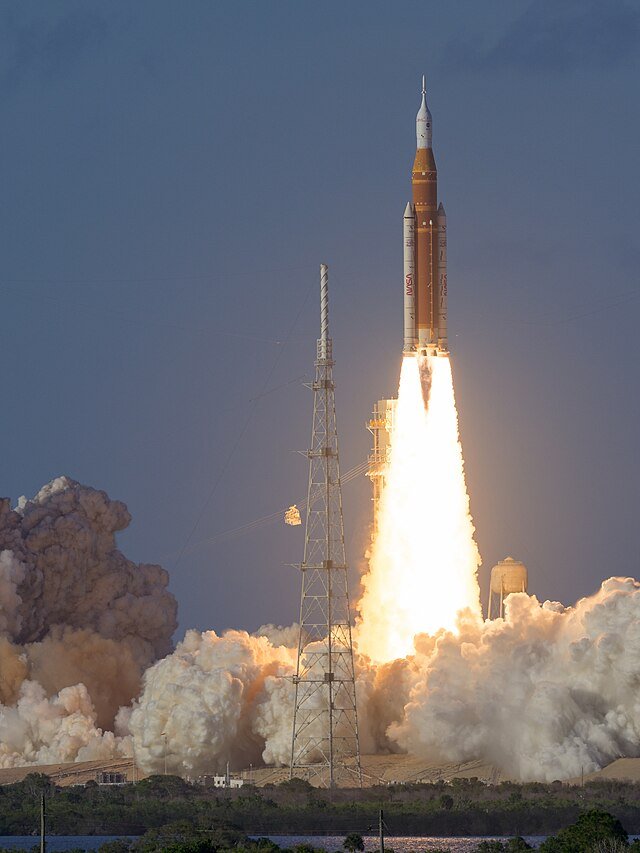
On April 10, 2026, the crew of the Artemis II mission splashed down in the Pacific Ocean before being recovered by NASA and the U.S. Navy. This mission, the first crewed spaceflight to the moon since 1972, marks a significant achievement in space exploration and the Artemis Program.
What is the Artemis Program?
Artemis is a NASA program composed of a series of increasingly difficult missions. Ultimate goals include establishing a base near the Moon’s south pole and laying the foundation for crewed missions to Mars.

The first Artemis mission, Artemis I, launched on November 16th, 2022, and tested two signature parts of the Artemis Program, the Space Launch System rocket and the Orion space capsule.
What is Artemis II?
Artemis II, building off of its previous mission, was the crewed flight version of the Artemis I trip. Launching on April 1, 2026, from the Kennedy Space Center in Florida, the crew consisted of 4 members: Americans Reid Wiseman, Victor Glover, Christina Koch, and Canadian Jeremy Hanse.

Like Artemis I, Artemis II conducted a “fly-by” of the moon, which is a manuever in which the spacecraft uses the gravity of the moon to change trajectory without entering the moon’s orbit. The main goals of this mission were to test life support systems and crew operations in the spacecraft.
After a 10-day trip, the crew splashed down into the Pacific Ocean on April 10, at approximately 8:07 PM

What Comes Next?
While Artemis II did conduct a flyby of the Moon, it did not land on the Moon, one of the main goals of the Artemis Program. The first Artemis mission to feature astronauts on the Moon is expected to be Artemis IV in 2028, 56 years after the last Apollo Program moon landing. While Artemis II was mainly a precursor for the larger, more significant missions expected to take place, its overwhelming success represents a big accomplishment for NASA and a positive outlook for those future missions.