
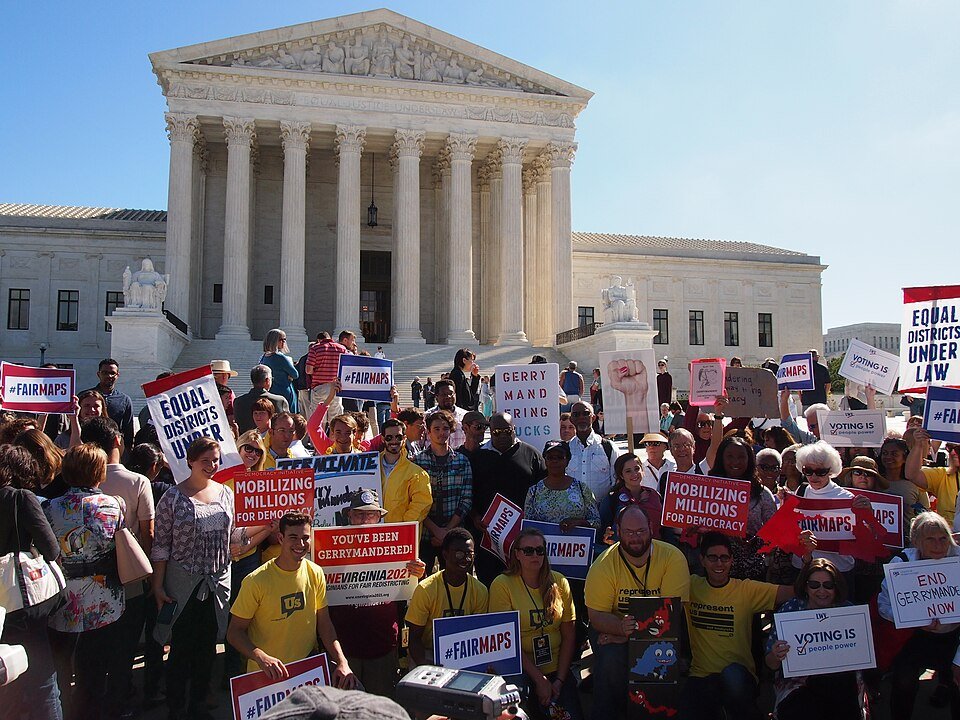
Across the country, states are redrawing their congressional district maps in hopes of controlling elected representatives in the House. Texas was the first to pass its own aggressively gerrymandered map in August 2025, and since then, California, Florida, and more have followed suit, and more are expected to as well. But first, what even is gerrymandering?

Gerrymandering is essentially the practice of redrawing congressional district maps to favor the election of representatives from a certain party. In this case, the gerrymandering that is in the headlines is the gerrymandering of U.S. congressional districts, which are the individual districts that members of the House of Representatives represent. Individual State governments have the right to decide on these congressional districts, as long as they have roughly identical populations. This is where gerrymandering comes in.
There are two basic techniques in gerrymandering: packing and cracking. Packing is the practice of cramming opposition groups into as few districts as possible, while cracking is the practice of splitting them across multiple districts.
For example, imagine a population with roughly 50/50 Democrats and Republicans. You are a Republican lawmaker, and you can only make 4 districts from this population. You consolidate, or “pack”, Democrat voters into one district, and then “crack” the other 3 districts so that each favors Republicans by a large majority. Since 50% of Democrats have already been “packed” in a single district, the other 50%, split across the other 3 districts, are likely to lose. Now, you have 3 Republican districts and only 1 Democrat district, rather than a 2-2 split if you were to divide districts evenly.

In Republican controlled Texas, lawmakers passed a new map in August 2025 that aims to turn 5 seats Republican. In November 2025, voters in California also passed a map in response to Texas’s map that would win 5 seats for Democrats. However, this process hasn’t gone as smoothly for other states.
In Virginia, a Democratic-favoring map passed by the state legislature was blocked by the Virginia Supreme Court, which found that the legislature violated the process when placing the measure on the ballot.
In April 2026, the U.S. Supreme Court sided with Louisiana Republicans against a 2024 Louisiana congressional district map that contained two majority-black districts. The U.S. Supreme Court found that the second majority- black district was an “unconstitutional racial gerrymander”, meaning the map relied too heavily on race, and cleared the way for the Louisiana State Government to redraw and remove the district.

The same thing happened again in Alabama in May, when the U.S. Supreme Court struck down Alabama’s map with two majority-black districts and paved the way for the Alabama state legislature to redraw. Both of these new maps in Alabama and Louisiana would favor Republicans winning more seats in the upcoming elections.
Ultimately, these redistricting battles happening across the country really up the stakes for the 2026 midterm elections, scheduled for November. All seats in the House are up for elections, and the gerrymandering occurring across the country is sure to shake up the current state of Congress.